Progress Data
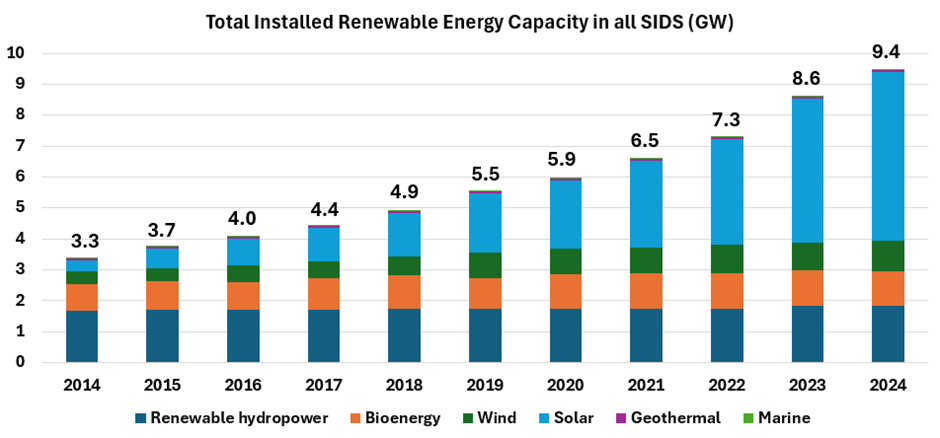
Small Island Developing States (SIDS) continue to demonstrate strong commitment to their sustainable energy transition. According to the latest IRENA statistics, total renewable energy (RE) capacity in all SIDS increasing to approximately 9.46 GW by the end of 2024, reinforcing the central role of clean energy in their power systems. Solar energy remains the leading technology, with installed capacity reaching 5.46 GW, reflecting widespread adoption across island nations. Hydropower capacity remains stable at around 1.82 GW, providing consistent and reliable generation. Bioenergy declined slightly by 2% (1.14 GW) in 2024, reflecting challenges such as volatile feedstock costs and the decommissioning of inefficient plants. Wind power shows steady growth, approaching 1 GW of capacity and increasingly contributing to electricity supply in several SIDS. Geothermal and ocean energy technologies continue, with a modest contribution of 1% (0.06 GW), as both technologies faced high upfront exploration costs and limited investment despite their potential to provide stable power.
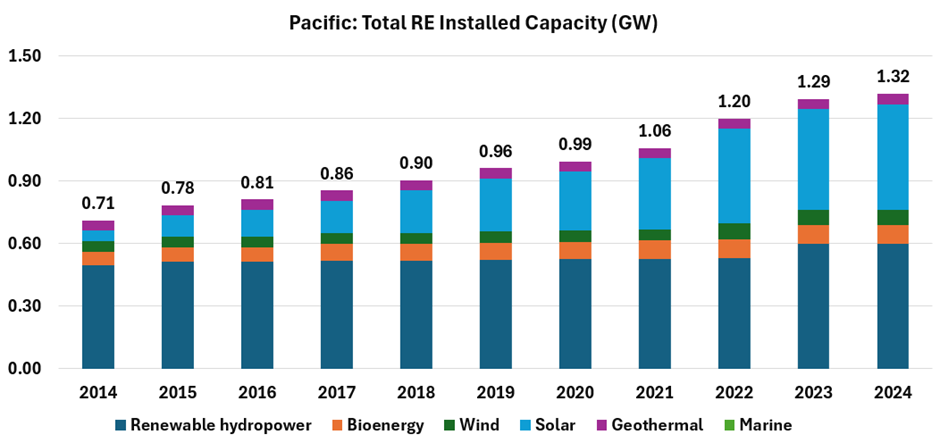
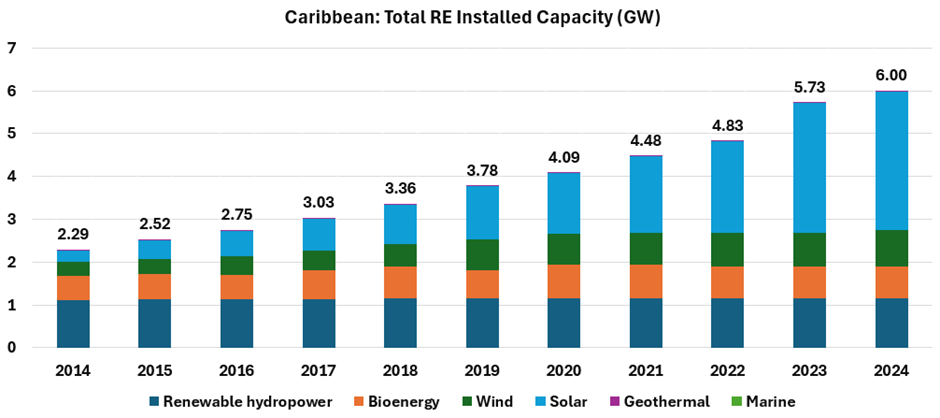
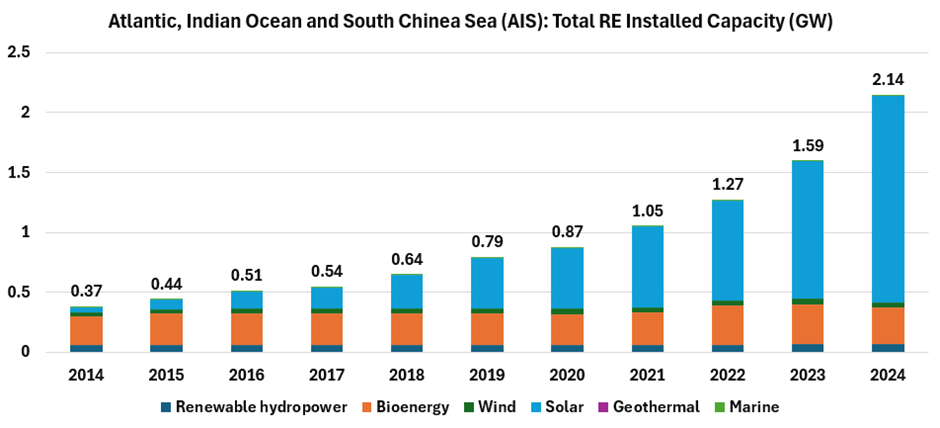
Within the period of 2014 to 2024, the Regional Profiles provide further insights into the distinctive trends observed in each of the three SIDS region. Specifically, the Atlantic, Indian Ocean, and South China Sea (AIS) region have embraced solar energy technologies, representing 80% of its total installed RE capacity at 1.41 GW in 2024. In the Caribbean region, renewable energy deployment is relatively balanced, with solar photovoltaics (PV) leading at 54% (3.03 GW) of total installed capacity, followed by hydropower (19%), wind (13%), and bioenergy (12%) of the total RE installed. Notably, the Pacific region is dominated by solar PV (0.57 GW) and hydropower (0.597 GW), which together account for 84% of the total RE installed capacity of 1.32 GW.